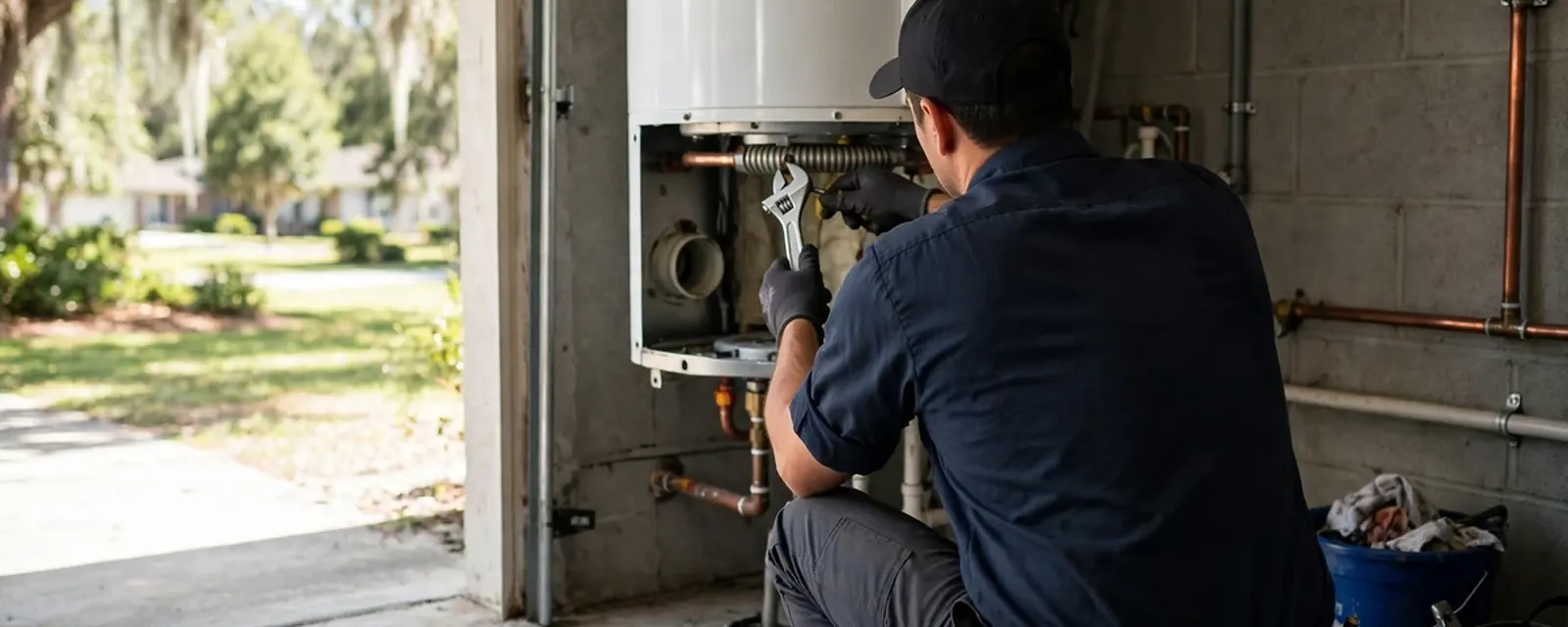
Every storage water heater carries a temperature and pressure relief valve, often called the T&P valve or the pressure relief valve. It sits near the top of the tank, usually on the side, with a short lever and a discharge pipe that runs down toward the floor. Its only job is to open if the tank gets too hot or the pressure climbs too high, and to let water out so the tank does not keep building pressure.
Most homeowners never think about it until it drips. A dripping relief valve is a warning, and the right response depends on why it is dripping.
What the valve does and why it matters
Water expands as it heats. In a tank that is open to the city supply, that extra volume pushes back into the pipes. In a system with a check valve or a pressure regulator, the water has nowhere to go, so pressure rises with every heating cycle. The relief valve is the escape route of last resort.
If the thermostat fails and the water keeps heating, the valve is also what stands between you and a tank that keeps building pressure. That is why plumbers treat it as a safety part, not an accessory. Never cap it, plug it or run a discharge line uphill.
Why a relief valve drips
High household pressure
Incoming pressure above normal pushes the valve open with each heating cycle.
Thermal expansion
A closed system with no expansion tank has nowhere for heated water to go.
Mineral buildup on the seat
Scale keeps the valve from sealing, so it weeps even at normal pressure.
Overheating
A failing thermostat lets the water get too hot. This is the serious case.
An old valve
Springs weaken and seats wear after years of cycling.
A valve that drips constantly may be doing its job, in which case replacing it only hides the real problem. A valve that drips lightly and has never been tested may simply be worn. A plumber can tell the difference by checking the incoming pressure, looking for an expansion tank and testing the tank temperature.
Valve dripping on your heater?
Call the 24/7 line and tell us how much water it is releasing.
When to replace the valve
- It drips continuously and household pressure and temperature check out normal.
- The lever is stuck, corroded or does not spring back when lifted gently.
- The valve is visibly crusted with mineral scale or has green corrosion at the threads.
- The water heater is more than about a decade old and the valve has never been replaced.
- The discharge pipe is missing, capped, undersized or pointed uphill.
How a replacement works
Shut off power or gas
Turn the heater off and let the water cool before work begins.
Relieve pressure
Close the cold supply, open a hot tap and lower the water level below the valve.
Swap the valve
Remove the old valve, clean the threads and install a correctly rated replacement.
Check the discharge
Make sure the discharge pipe is full size, runs downhill and ends in a safe, visible spot.
Restore and test
Refill, bring back power or gas and check for leaks and normal pressure.
Choosing the right valve matters. It has to match the tank's pressure and temperature ratings and the thread size, and the probe has to reach into the tank water. A mismatched valve can fail to open when it should or open too early. A plumber confirms the ratings from the tank label.
Do not test it carelessly
Manufacturers often recommend lifting the lever briefly once a year to check that water flows and the valve reseats. Do it only with a bucket or a discharge pipe in place, because the water can be very hot. If the valve does not reseat and keeps dripping afterward, it needs to be replaced.
If a valve discharges a lot of water or steam, shut off power or gas to the heater and call. That can mean overheating, and the response is urgent. Our water heater repair page lists the emergency steps.
The expansion tank question
Many homes have a pressure regulator or check valve where the water line enters the house. That closes the system, so thermal expansion has nowhere to go. A small expansion tank near the heater absorbs the extra volume and protects the relief valve and the tank. If your valve drips regularly and no expansion tank is installed, that is the likeliest fix, and it is often better than replacing the valve alone.
When we replace a tank, we check this as part of the job. See water heater replacement for the full list of things we look at, including earthquake strapping and a safe discharge route.
What a safe discharge pipe looks like
The relief valve is only half of the safety system. The other half is the pipe that carries discharged water away. It should be the same size as the valve outlet or larger, it should run downhill without any rise, and it should end where hot water or steam cannot hurt anyone, such as outdoors or over a floor drain.
Common mistakes include threading a cap on the end, reducing the pipe to a smaller size, running it into a bucket that can fill and tip, and terminating it in a spot where a child or pet could be scalded. Any of those can turn a safety device into a hazard. If your discharge pipe is missing or short, fixing it is as important as replacing the valve.
How to tell a nuisance drip from a warning sign
| What you see | What it often means | What to do |
|---|---|---|
| A few drops after the heater runs | Thermal expansion in a closed system | Ask about an expansion tank. |
| A steady trickle all day | A worn seat or high household pressure | Check pressure, then replace the valve. |
| A burst of water that stops | The valve opened on a pressure spike | Test the pressure and look for a missing tank. |
| Steam or very hot water | Overheating | Shut off power or gas and call right away. |
Take a moment to look at the heater's temperature setting too. Many tanks ship set high, and lowering the setting a little reduces both scalding risk and stress on the tank. If you are unsure what your thermostat is doing, a plumber can check it with a thermometer at a nearby tap.
Common questions on cost and timing
A valve itself is an inexpensive part. Most of the price of a replacement visit is the plumber's time, the pressure check and any related fix, such as an expansion tank or a corrected discharge pipe. We explain which items apply before work starts, and we tell you if the valve is not the real problem.
Replacing a valve usually takes a short visit, but it requires draining some water from the tank, so plan for a brief interruption in hot water. If your heater is already old, ask about the tank's overall condition while the plumber is there, because a corroded tank is a better reason to plan a replacement than a new valve.
Relief valves and permits in Monterey Park
The City of Monterey Park lists water heater replacement as work that requires a plumbing permit. Replacing only the valve is a smaller job than replacing the heater, so ask the City's building department whether your repair needs a permit before work starts.
Water in Monterey Park comes mostly from local groundwater wells operated by the City, and the City's 2010 water quality report listed total hardness around 12 grains per gallon. Mineral-heavy water can coat a relief valve seat with scale over time, so a valve that has never been touched may deserve a look when you flush the tank.
Questions about relief valves in Monterey Park
A slow drip is usually not, but a heavy flow of water or steam is. Shut off power or gas to the heater and call if it is flowing hard.
It is possible, but the ratings, the discharge pipe and the pressure check matter, so many homeowners prefer a plumber. Never plug the valve.
Often a decade or more, but they can fail sooner in hard water. They are cheap compared with the tank they protect.
Rules for a valve-only repair are not something we can state for you. The City lists water heater replacement as needing a permit, so ask the building department about a smaller repair.
Often thermal expansion in a closed system. An expansion tank usually solves it.
Sources and where to confirm
Local facts and rules on this page rest on the City's 2010 water quality report, the building department and the California Plumbing Code. Confirm anything that affects your own property with the source.
- City of Monterey Park Water Division, water quality report (2010 edition cited here). Ask the Water Division for the current report.
- City of Monterey Park building department, plumbing permit requirements, including water heater replacement.
- California Plumbing Code (the state's adoption of the Uniform Plumbing Code, UPC), enforced locally by each city's building department.