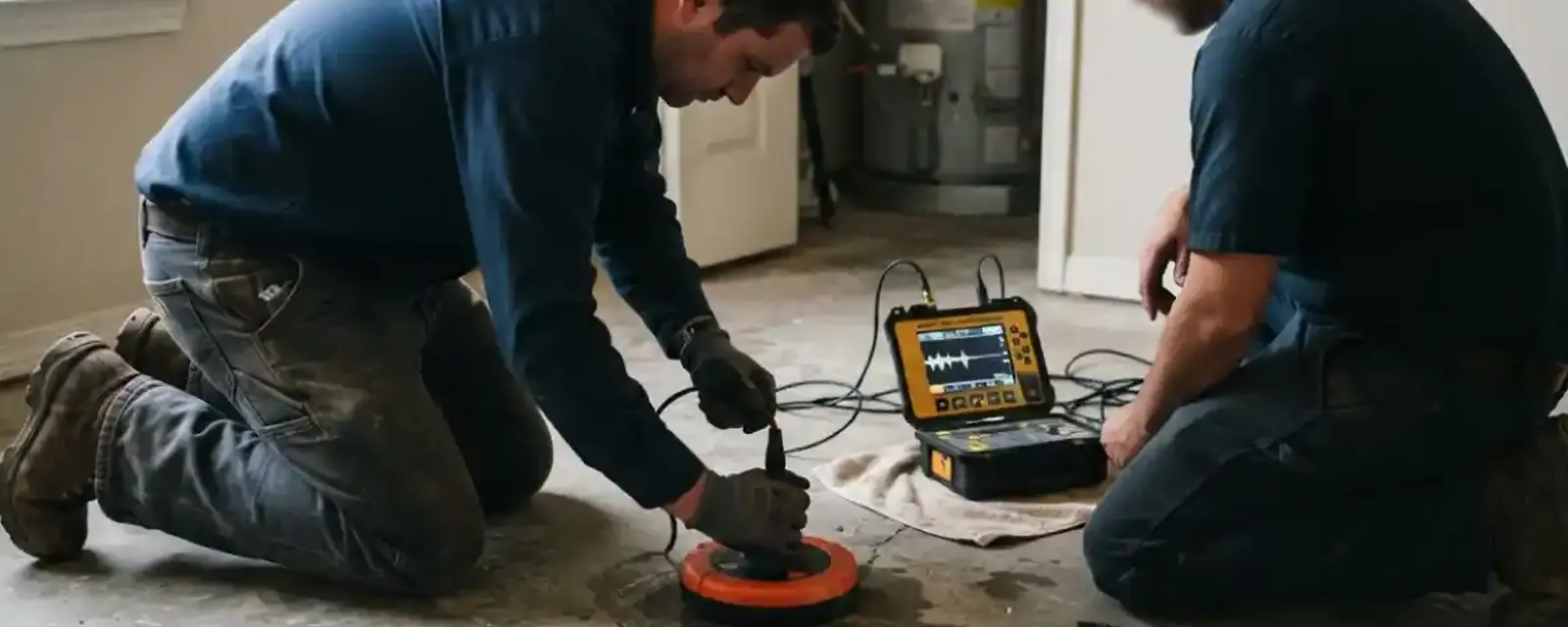
Homeowners often ask whether they should repair a slab leak or repipe the house. The question mixes a problem with a solution. A slab leak is where the water is escaping. Repiping is a larger project that replaces the supply system. They are not opposites, and sometimes the right answer is one, sometimes the other.
What each one means
| Slab leak repair | Repiping | |
|---|---|---|
| What it is | Fixing a leak in a pipe in or under the slab | Replacing the water supply lines in the home. |
| Scope | One line or one section | Whole house or large sections. |
| Disruption | Opens the floor at the leak or reroutes | Opens walls and ceilings. |
| Best when | One failure in otherwise sound pipe | Failures are repeating or the pipe is at end of life. |
| Typical cost | Smaller | Larger. |
The three ways to deal with a slab leak
- Spot repair: open the slab at the leak and replace the damaged section.
- Reroute: abandon the leaking line and run a new one through walls or the attic.
- Repipe: replace the supply system more broadly so the slab lines are no longer used.
Our slab leak repair page describes how we locate and repair the leak, and our repiping page covers the larger option.
Not sure whether you need a repair or a repipe?
Call and describe the leak history.
How to decide
How old is the pipe?
Old pipe is more likely to fail again somewhere else.
What material is it?
Some materials have known failure patterns.
How many leaks so far?
A second or third leak is a pattern.
Where does the pipe run?
If most of it is under the slab, rerouting may beat repeated floor openings.
What is your plan for the house?
Staying long term favors the lasting fix.
Do not skip the locate
Before anyone breaks concrete, the leak must be found. A bad locate leads to the wrong hole. Pinpointing also tells you whether the leak is in a hot or cold line, which hints at the cause and the next steps. Our leak detection page explains the process.
Insurance and records
Policies vary, but many cover water damage from a sudden leak and some cover the cost of access. Few cover the pipe itself. Document what you find, keep invoices and ask your insurer before work starts.
What happens during each option
Confirm the leak
Pressure-test the lines and listen to find which one is leaking.
Locate it
Pinpoint the spot with listening and thermal tools.
Choose a path
Pick spot repair, reroute or repipe based on the pipe and the number of failures.
Do the work
Open the slab, run the new line or replace the system.
Test and restore
Pressure-test, patch the opening and make sure the water is clean.
Cost thinking without numbers
A spot repair costs less than a repipe on the day. A repipe can cost less over the life of the house if it avoids the third and fourth leak. The way to think about it is to ask how likely another failure is within the next several years. If the answer is very likely, the larger project is not extra, it is a way of paying once.
That calculation depends on facts we can only get by looking: the pipe material, its age, its condition at the cut and the number of earlier failures. Ask any contractor to show you the failed section, and if you can, keep the cut piece.
Questions to ask before you approve
- Where exactly is the leak, and how was it found?
- Is the pipe copper, PEX or something else, and what condition is it in elsewhere?
- What will you open, and what flooring will need replacing?
- Is a reroute possible, and what would it involve?
- What is the warranty on the repair, and does it cover a new leak nearby?
Warning signs that point to a bigger problem
- Hot water takes much longer to arrive than it used to, suggesting a leak in the hot line.
- Your water bill climbs for several months in a row with no change in use.
- You hear running water when every tap is closed.
- Floors feel warm in a specific spot, or flooring has started to buckle.
- You have had a leak before in the same house, and the pipe looks similar to the failed one.
Any one of these is a reason to call. Several together make it likely that a locate is needed, and a decision about the larger project may come soon after.
A note on warranties
Ask what the warranty covers and for how long. Some warranties cover only the section that was repaired, and a new leak a few feet away is not covered. A reroute or repipe warranty usually covers the new lines, but not the old ones left in place. Understanding that before you approve the work helps you set expectations.
Talking to your insurer and your neighbors
Tell your insurer as soon as you suspect a slab leak, before work begins, so an adjuster can see the damage if they wish. If you live in a townhome or condominium, a slab leak can involve shared walls or a shared foundation, so tell the association too. Keep photos, the locate report and the invoice together. Those records make a claim, a resale disclosure or a dispute much easier to handle later.
Slab foundations in Monterey Park
Many Monterey Park homes sit on concrete slab foundations, and in older houses the supply lines may be decades old. Repiping and rerouting generally need a plumbing permit and inspection, and the City of Monterey Park's building department decides what applies to your project.
Water chemistry affects how pipe ages. The City supplies most of the community from local groundwater wells, and its 2010 water quality report listed total hardness around 12 grains per gallon, with a range of 4 to 24. Ask the Water Division for its current report if you are weighing a repipe, and consider testing your tap.
Questions about slab leak repair versus repiping in Monterey Park
No. One failure in sound pipe is often a spot repair or a reroute.
Abandoning the leaking line and running a new one through walls or the attic, so the slab is not opened.
Repeated leaks, discolored water, falling pressure and old pipe material are the signs.
Repipes and reroutes generally do. Ask the City of Monterey Park building department.
Yes, when the rest of the system is in good shape.
Sources and where to confirm
Local facts and rules on this page rest on the City's 2010 water quality report, the Water Division, the building department and the California Plumbing Code. Confirm anything that affects your own property with the source.
- City of Monterey Park Water Division, water quality report (2010 edition cited here). Ask the Water Division for the current report.
- City of Monterey Park Water Division, for questions about your meter, billing and the utility side of the line.
- City of Monterey Park building department, plumbing permit requirements, including water heater replacement.
- California Plumbing Code (the state's adoption of the Uniform Plumbing Code, UPC), enforced locally by each city's building department.