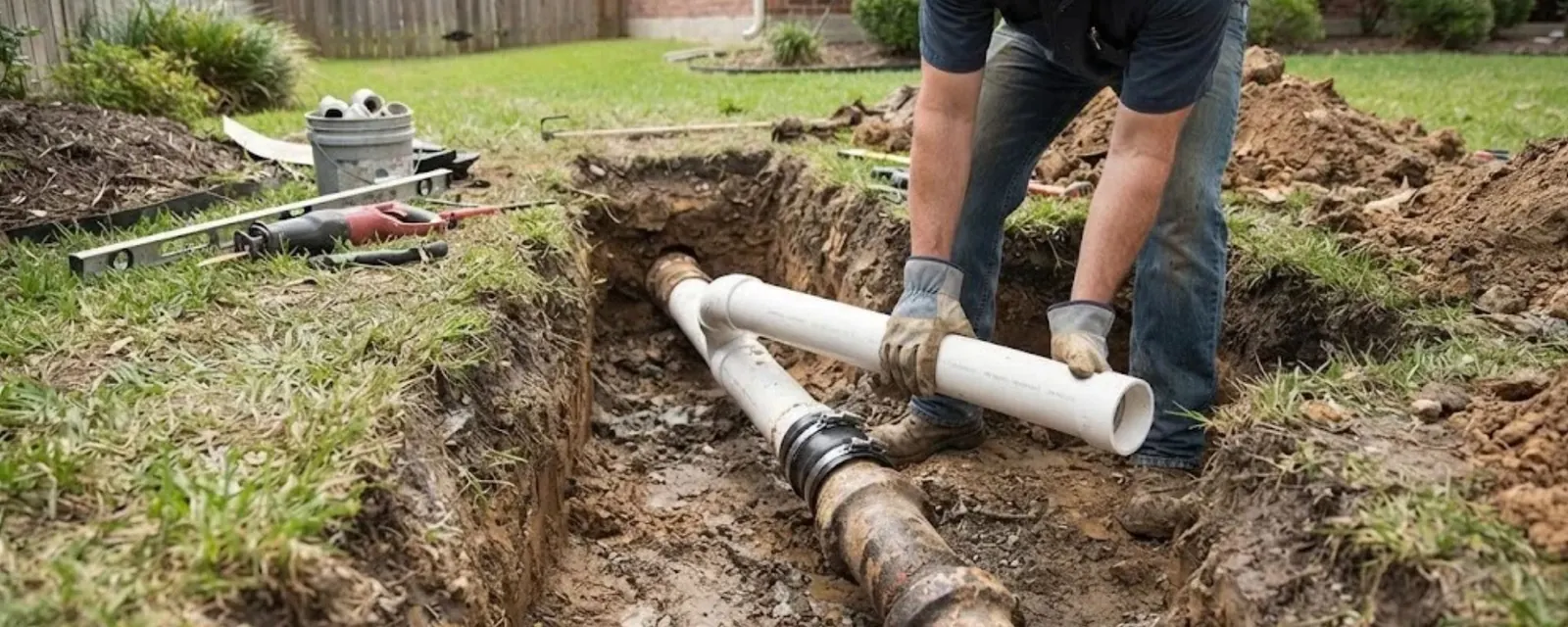
Pipe lining, also called cured-in-place pipe lining, creates a new pipe inside the old one. A flexible liner soaked in resin is pulled or inverted into the damaged pipe, pressed against the walls and cured until it hardens. The result is a smooth pipe with no joints inside the original, with no trench across the yard.
When lining makes sense
- Cracks, joint separations or root intrusion in a pipe that is otherwise round and continuous.
- Pipe that runs under a driveway, patio, slab or landscaping that is expensive or impractical to dig.
- Older clay, cast iron or Orangeburg pipe that is deteriorating but has not collapsed.
- A line where cleaning and roots removal has to be repeated again and again.
When it does not fit
- A collapsed or severely misaligned pipe, where the liner cannot pass or cannot hold its shape.
- A pipe with a major belly, where water pools and a liner would simply preserve the dip.
- A line with so many connections or bends that installation is impractical.
- Pipe that is too damaged to be cleaned first. Lining over debris fails.
A camera inspection decides this. Our sewer camera inspection page explains what we look for, and our sewer line repair page covers the other paths, including spot repair and full replacement.
Wondering if your sewer pipe can be lined?
Call and ask about a camera inspection first.
How lining is done
Inspect with a camera
Confirm the pipe's condition, length and any bends or collapses.
Clean thoroughly
Remove roots, scale and debris. Hydro jetting is often used.
Install the liner
Pull or invert the resin-soaked liner into place.
Cure
Use steam, hot water or light to harden it.
Reopen and inspect
Reinstate connections and run a final camera check.
Lining versus digging
| Factor | Lining | Open trench |
|---|---|---|
| Disturbance | Small access points | A trench through landscaping or hardscape. |
| Best for | Cracks, roots, joint failures | Collapses and serious misalignment. |
| Pipe slope | Preserves the existing slope | Can correct slope. |
| Cost drivers | Length, diameter, access | Depth, surface restoration. |
| Time | Often shorter | Often longer. |
No method is automatically better. The right one depends on what the camera shows and what sits on top of the pipe.
Questions to ask a contractor
- What does the camera show, and can I see the recording?
- How will the pipe be cleaned before lining?
- What material and thickness is the liner, and what warranty does the manufacturer offer?
- How are the connections to other lines reinstated?
- Is a permit needed, and who pulls it?
Why the cleaning step decides the result
A liner can only bond to a clean pipe wall. Roots, scale, grease and old debris prevent it from sticking and leave voids behind it. For that reason, lining always starts with thorough cleaning, usually with a mechanical cutter or high-pressure water. A contractor who skips or rushes this step is setting up a failure.
After cleaning, a camera should show a clear, open pipe. If the inspection finds a hole large enough that soil is washing in, or a section so deformed that equipment cannot pass, lining may not be possible without excavating that section first. A good contractor shows you the footage and explains the plan rather than asking for blind trust.
What lining can and cannot do
| It can | It cannot |
|---|---|
| Seal cracks, offset joints and root entry points | Raise a belly or correct a pipe that dips. |
| Restore a smooth wall inside old pipe | Rebuild a collapsed section. |
| Avoid trenching under slabs and hardscape | Replace a missing piece of pipe. |
| Stop roots from re-entering at the joints | Fix a problem in the house plumbing above the line. |
Lining also reduces the inside diameter by a small amount. For most residential lines, the smoother surface makes up for that, but on a pipe that was already small or heavily scaled it deserves a conversation. Ask the contractor what diameter your line will be after lining.
Planning for the day of the work
Lining a line takes the sewer out of service for part of a day or more, and you cannot use drains in the house during that time. Plan for showers, laundry and dishes. In a condominium or townhome, coordinate with neighbors who share the line and notify the HOA before work begins.
Ask where the equipment will be set up, whether a cleanout exists and who restores any small excavation. If your line has no accessible cleanout, adding one is often a good investment because it makes future cleaning and inspection easier.
Warranty and record keeping
Lining is a long-term repair, and the paperwork matters. Ask for the manufacturer's warranty, the installer's warranty, the before and after camera footage and the liner specification. Keep them with your house records, since a buyer's inspector may ask for them when you sell.
Be clear on what the warranty covers. Some cover only the liner, not the connection to the rest of the line or damage from a failure upstream. Read the exclusions before you sign.
Signs your sewer line may need attention
- Slow drains in several fixtures, especially the lowest ones in the house.
- Gurgling from toilets or tubs when another fixture drains.
- Sewage smells in the yard or near a cleanout.
- Soggy patches of lawn above the line.
- Repeated clogs that return after cleaning.
Any of those is a reason for a camera inspection. The camera shows whether lining, spot repair or replacement fits.
Sewer repairs and permits in Monterey Park
Sewer laterals in Monterey Park serve a wide range of housing, from older houses near the historic Midwick View Estates to condominium and townhome buildings. Where the private lateral ends and the public sewer begins can vary by property, and we do not state it here. Ask the City of Monterey Park's Public Works department which portion of your line is yours before you commission a repair.
Repairs to a sewer lateral often need a plumbing permit and inspection. The City's building department can tell you what applies to a lining project. Keep the before and after camera recordings, since they document the repair for resale and any later claim.
Questions about pipe lining in Monterey Park
Often only small access points, though a damaged section or a missing cleanout may need a small excavation.
Manufacturers describe long service lives, but actual life depends on the old pipe's condition and installation quality. Ask for the warranty terms.
No. A camera inspection decides, because collapsed or badly misaligned pipe cannot be lined.
Slightly, but a smooth liner often flows as well as or better than a rough old pipe.
It depends on the property. Ask the City's Public Works department.
Sources and where to confirm
Local facts and rules on this page rest on the building department and the California Plumbing Code. Confirm anything that affects your own property with the source.
- City of Monterey Park building department, plumbing permit requirements, including water heater replacement.
- California Plumbing Code (the state's adoption of the Uniform Plumbing Code, UPC), enforced locally by each city's building department.