Search results for tankless installation cost are full of ranges, and the ranges are wide for a reason. Two homes can buy the same unit and end up with very different totals because of what has to change around it. We do not publish a flat price here, because a number that ignores your gas line would mislead you. We can explain what moves the price and what to ask for in a quote.
What goes into the installed price
| Component | What it covers | Why it varies |
|---|---|---|
| The unit | Heater sized for your flow needs | Capacity, efficiency and features differ. |
| Gas line | Supply pipe from the meter or branch | Tankless units draw more gas at once than a tank. |
| Venting | Exhaust and intake routing | Distance and wall or roof penetrations change the work. |
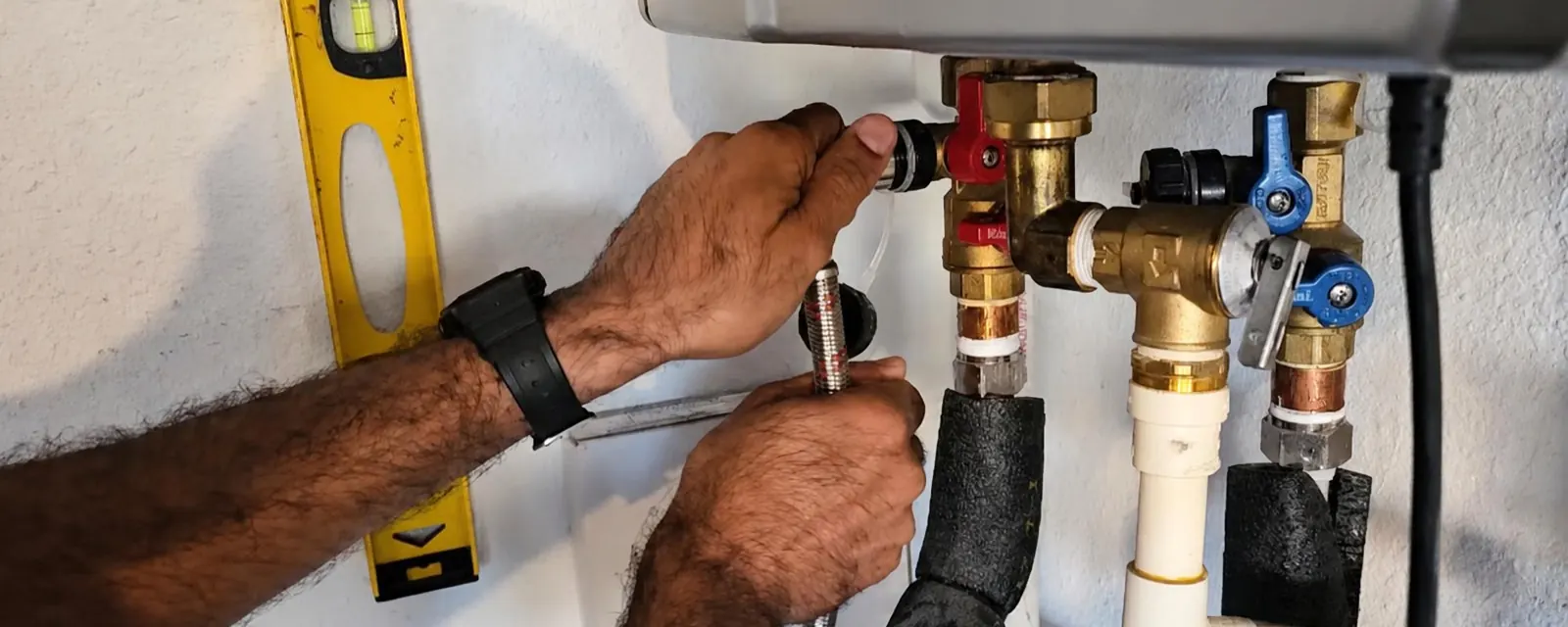
| Water connections | Supply, isolation valves and a way to flush | Reusing old piping versus rework. |
| Condensate and drain | For condensing models | Needs a drain path and sometimes a neutralizer. |
| Electrical | Outlet for controls and fan | May need a new circuit. |
| Permit and inspection | City review of the work | Depends on the scope. |
| Removal of the old tank | Draining, disconnecting and hauling | Access and size. |
The first two rows deserve special attention. A tank heater lights a burner at a modest rate for a long time. A tankless unit lights at a high rate for a short time, so it needs a gas line that can deliver that burst. In many older homes, the gas line to the heater was sized for the tank and has to be enlarged.
Why the gas line is the surprise
Gas piping capacity depends on pipe diameter, length and how many appliances share the line. Adding a tankless heater to a line that also feeds a range, a furnace and a dryer can overload it. A plumber calculates the load before quoting. If the existing line is too small, the upgrade can cost as much as the heater.
Want a tankless quote for your house?
Call and describe your gas line and where the heater sits.
Venting and where the unit can go
Gas tankless units need to exhaust combustion gases outdoors. Some use special stainless venting, others use plastic pipe if they are condensing models. The route from the unit to the outside, the clearances from windows and the roof or wall termination point all affect labor.
Moving the heater is possible but expensive. Replacing it in the same spot usually costs less, unless the old flue cannot be reused. A closet in a condo with a shared vent chase can restrict choices, and HOA rules may apply.
Condensing versus non-condensing
Condensing units extract more heat from exhaust and need a condensate drain, and their vent can often be plastic. Non-condensing units use a hotter flue and need metal venting. Condensing models cost more up front and may use less gas. Which is better depends on your usage and the venting path you have.
Questions to ask any plumber who quotes you
- Did you check the gas line capacity, and is an upgrade included?
- What venting material and route are you planning?
- Does the quote include the permit, the old tank removal and an isolation valve set for flushing?
- What happens to the price if the inspector requires an additional change?
- What is the flow rate of the unit, and does it suit the number of showers and appliances we run at once?
Is tankless worth it?
Tankless heaters save floor space and end the problem of running out of hot water from a small tank. They do not heat water for free, and savings depend on how much hot water a household uses. In a household with light use, the savings may take a long time to cover the extra install cost. In a household with heavy use or limited space, it can make sense.
Our tankless water heater page explains maintenance, flushing and repair, and our water heater installation page covers the planning side.
Sizing: why bigger is not always better
Tankless units are rated in gallons per minute at a given temperature rise. The temperature rise is the gap between the incoming water and the temperature you want, and incoming water is colder in winter. A unit that handles two showers on a mild day may struggle on a cold one.
Oversizing adds cost and gas demand without helping comfort, while undersizing leaves you with lukewarm water when fixtures overlap. A plumber adds up your peak flow, picks a rating with some margin and checks that the gas line can feed it. That calculation takes a few minutes and avoids the most common complaint about tankless heaters.
Hidden items that change a quote
- An old flue that cannot be reused and must be replaced or capped.
- Gas shutoff valves or sediment traps that are missing or out of date.
- Removal of the old tank, including its earthquake strapping and drain pan, and any wall repair where it stood.
- A recirculation line, if you want hot water at distant fixtures without a long wait.
- Water treatment such as a softener or scale filter, if the manufacturer's warranty ties coverage to water quality.
- Wall repair and paint where the old tank sat or where new vent holes were cut.
Running costs after installation
Installation cost is only part of the picture. A tankless heater avoids standby heat loss from a stored tank, which can reduce gas use, but the savings depend on how much hot water your household draws. A large family that uses hot water all day will see a different result than a couple who use it briefly.
Maintenance is a cost too. Plan for periodic flushing with descaling solution, an occasional inlet filter cleaning and a check of the venting. These are small jobs, and skipping them is the reason many units develop error codes and lose output.
What to know about tankless installs in Monterey Park
The City of Monterey Park lists water heater replacement as work that needs a plumbing permit, and a tankless conversion typically involves new gas piping and venting that fall under the same review. Ask the building department what your project requires, and keep the final inspection record for resale.
The City's water system draws on local groundwater, and its 2010 water quality report listed total hardness around 12 grains per gallon with a range of 4 to 24. Scale inside a tankless heat exchanger narrows the water path and can trigger error codes, so plan for periodic flushing, and ask the Water Division for its current report to see where your water falls.
Questions about tankless installation in Monterey Park
Gas line size, venting route, unit capacity and permit scope differ from home to home. Compare what each quote includes, not just the total.
Not always, but often. A plumber should calculate the load before quoting.
Sometimes, depending on venting and HOA rules. Ask your association before ordering a unit.
Often a day, longer if gas piping or venting needs rework.
Mineral scale builds up over time. Regular flushing helps, and a softener may be worth considering. See water softener.
Sources and where to confirm
Local facts and rules on this page rest on the City's 2010 water quality report, the Water Division, the building department and the California Plumbing Code. Confirm anything that affects your own property with the source.
- City of Monterey Park Water Division, water quality report (2010 edition cited here). Ask the Water Division for the current report.
- City of Monterey Park Water Division, for questions about your meter, billing and the utility side of the line.
- City of Monterey Park building department, plumbing permit requirements, including water heater replacement.
- California Plumbing Code (the state's adoption of the Uniform Plumbing Code, UPC), enforced locally by each city's building department.